Harris County was originally Harrisburg County, named for John Richardson Harris
Harris County’s name traces to Harrisburg, the Buffalo Bayou settlement John Richardson Harris founded in 1826, and its footprint still lingers in Old Harrisburg.
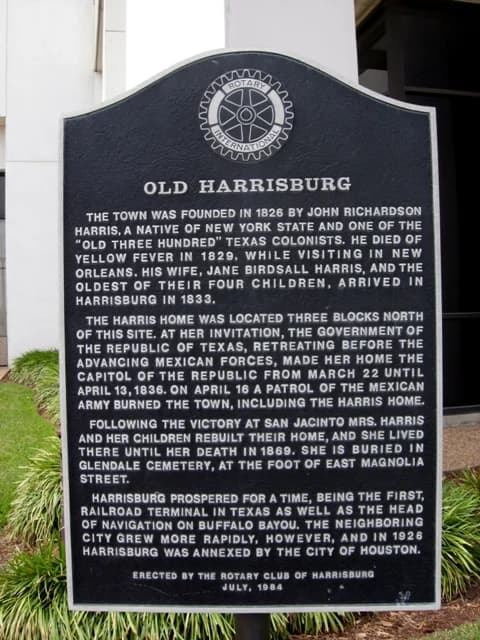
Harris County began as Harrisburg County, and that older name still points straight back to John Richardson Harris and the Buffalo Bayou settlement he founded in 1826. The county did not spring up as an abstract boundary on a map: it evolved from a frontier community, a wartime upheaval, and the rapid rewriting of local government after Texas won independence.
From Harrisburg to Harris County
Harrisburg was the largest town and seat of government for the area that would become the county’s geographic core. By December 1835, the Provisional Government of Texas had defined the boundary of the Municipality of Harrisburg in a way that closely resembles the footprint of Harris County today, which is why the county’s origin story starts before statehood, and even before the Republic fully took shape.
The name change followed the political shift of 1836. The Texas Constitution turned municipalities into counties, and after the Battle of San Jacinto on April 21, 1836, the new republic’s leaders moved quickly to organize county government. The Harris County Historical Commission marker text says the First Texas Congress completed that structure after independence, locking in the transition from municipal boundaries to county lines.
John Richardson Harris is the person at the center of that story. Texas historical sources identify him as an early Texas settler and the founder of Harrisburg, and one historical record gives his life dates as Oct. 22, 1790, to Aug. 21, 1829. That means he did not live to see the county that would eventually bear his name, but his settlement still shaped the map that followed.
Why Harrisburg still matters in Houston geography
Harrisburg was burned by Mexican forces in April 1836 during the Texas Revolution, and that damage matters because it helps explain the city’s later decline. Houston eventually eclipsed Harrisburg as the dominant city in the region, while the older settlement receded into local memory as Old Harrisburg.
That is why Harris County’s history is still visible in modern Houston-area geography. The old settlement corridor on Buffalo Bayou remains the cleanest way to understand how the county formed, and the Harrisburg name survives as a marker of the place that once anchored the region before Houston’s rise. The history is not just in archives; it is still written into the way locals talk about the east side, the bayou corridor, and the older communities that predate the modern metro.
The Newberry Library’s Texas Atlas of Historical County Boundaries and the Harris County marker materials both show that Harrisburg’s municipal footprint was an early administrative precursor to county lines. That makes Harris County a strong example of how Texas government grew out of settlement corridors, river traffic, and the reorganization that followed the revolution.
Where to see the story today
The surviving evidence is scattered across place names and public markers rather than concentrated in one grand memorial. If you want to follow the county’s origin story in the field, start with the names that still point back to Harrisburg.
- Buffalo Bayou: the founding corridor John Richardson Harris chose in 1826, and the geographic spine of the whole story.
- Old Harrisburg: the surviving place name that marks the settlement Harrisburg became after Houston rose.
- Harris County Historical Commission marker: the clearest public explanation of how the Municipality of Harrisburg became part of the county’s foundation story.
- Greater East End: part of Houston’s eastside geography, where the older settlement pattern still sits beneath the modern city.
That map tells you what the county was before it became what it is now. Harris County was originally called Harrisburg County, and the county’s namesake was not a later political figure or the city of Houston, but John Richardson Harris himself, the founder of Harrisburg.
Quick fact box
- Founding of Harrisburg: 1826
- Municipality boundary defined: December 1835
- Texas wins independence: April 21, 1836, at San Jacinto
- County government reorganized: 1836, under the Texas Constitution and the First Texas Congress
- Harris County Sheriff’s Office founded: 1837
- County size: 1,788 square miles, including 1,729 land square miles
- Incorporated municipalities: 41
- Population: more than 4.1 million
The Harris County Sheriff’s Office uses those figures to show the scale of the county today, and they underline how far the region has traveled from its Harrisburg beginnings. An 1837 county institution now serves one of the largest urban counties in the United States, but its name still carries the imprint of a river town on Buffalo Bayou.
The county’s identity is easier to understand once you start at Harrisburg. The old name, the old settlement, and the old bayou corridor still explain the modern map, which is why Harris County’s founding story remains visible in the places people pass every day.
This article was produced by Prism’s automated news system from verified source data, official records, and press releases, then run through automated quality and moderation checks before publishing. The system is built and supervised by the people who set the standards it runs under. Read our full AI policy.
Did this article answer your question?