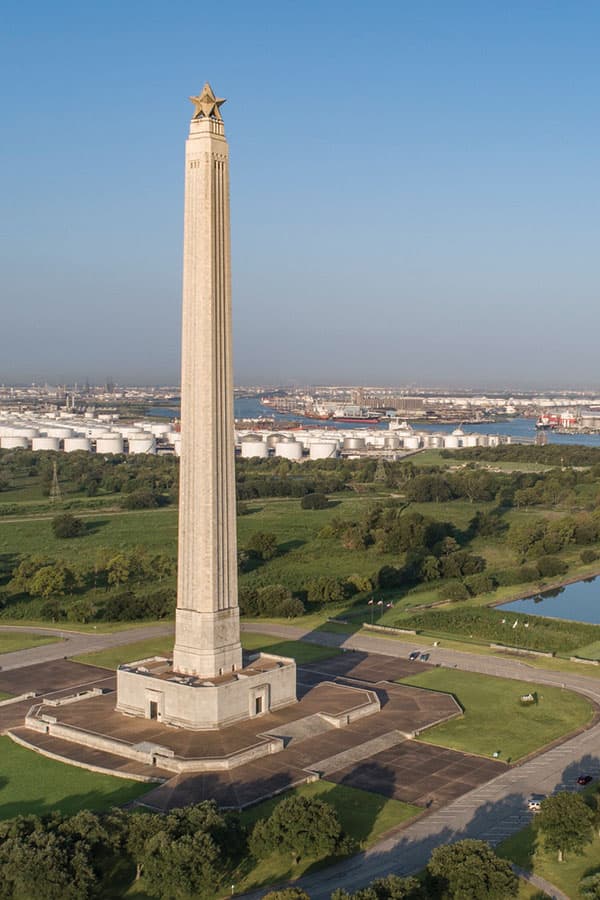
San Jacinto Monument in La Porte rises 567.31 feet over Harris County, a height that makes it the world’s tallest war memorial and puts it nearly 15 feet above the Washington Monument. That one number is the easy hook, but the larger draw is the full site around it: an 18-minute battlefield, a 1,268-acre historic landscape, and a view of the Houston Ship Channel that ties Texas history to the county’s working waterfront.
Why this monument still matters
The monument commemorates the April 21, 1836, victory in which Sam Houston and his men defeated Antonio López de Santa Anna’s army at San Jacinto. The Texas Historical Commission identifies that fight as an 18-minute battle, a short encounter with long consequences for Texas independence and westward expansion. The battlefield and monument later became a National Historic Landmark on December 19, 1960, which gives the site a status that reaches well beyond a local roadside stop.
The visitor numbers tell the same story. More than 1 million people came to the monument in its first three years, a sign that this was never just a niche stop for history buffs. The centennial-era project that created it was meant to be public-facing from the start, and the museum history notes that on February 15, 1938, the San Jacinto State Park Commission asked George A. Hill, Jr. to chair a museum board for the project. Houston’s centennial effort eventually became a monument, a museum, and a battleground destination that still anchors La Porte today.
What is on site
The monument is not just a vertical marker in a field. At the top sits a 34-foot star that weighs 220 tons, and the structure was built in situ, with the star and shaft completed in just 20 days. The construction detail is part engineering feat, part Texas lore: 150 men worked around the clock in 57 hours of eight-hour shifts, only 35 of them had construction experience, and they went through 3,800 sandwiches and 5,700 cups of coffee to finish the job.
At the base, the Art Moderne design tells the story of the War of Texas Independence in fewer than 600 words. That compressed narrative is part of what makes the site useful for families, school groups, and visitors who want context without spending half a day in a gallery. Panels, battle flags, and memorial inscriptions connect the monument to the larger Texas Revolution story, while the museum inside the monument gives the visit a second layer beyond the exterior view.
The site also feels unmistakably local because of what you can see from it. The Monument Cam looks out over the Houston Ship Channel, which keeps the place rooted in the geography and industry of Harris County rather than floating as a stand-alone monument. It is one of the few local landmarks where state history and the working edge of Houston can be seen in the same frame.
The engineering story behind the superlative
The monument’s shellstone walls are made of Texas Cordova shellstone, geologically known as Whitestone Lentil, and that stone formed more than 105 million years ago. That detail gives the structure a deep-time dimension that is easy to miss if you only know it as a war memorial. The building material links the monument not just to Texas history, but to the ancient geology under the Gulf Coast.
The monument is also described as the world’s tallest masonry column, a related distinction that helps explain why it stands out even among famous towers and memorials. For visitors, that means the appeal is not limited to patriotism or local pride. The site combines scale, material, design, and commemoration in a way that few other Houston-area attractions can match.
How to plan a meaningful visit
San Jacinto works well as a weekend outing because the site offers more than a single photo stop. The Texas Historical Commission says the San Jacinto Battleground State Historic Site includes self-guided driving tours, hiking, birdwatching, fishing, and museum visits, so a trip can be as active or as leisurely as you want. The battleground itself is broad enough, at 1,268 acres, to reward visitors who spend time outside the monument tower and museum gallery.
That flexibility is part of the attraction for Harris County families. You can build the day around the monument’s observation and history, then use the rest of the site for a walk, a drive, or a quiet break near the battleground. The result is not a generic heritage trip and not just an outdoor excursion. It is a place where the county’s public history, its landscape, and its waterway all meet in one stop.
What makes it different from other Houston-area outings
A lot of local outings ask you to choose between nature, architecture, or history. San Jacinto gives you all three at once, with a battlefield that marks a decisive moment in Texas history, a monument that is still the world’s tallest war memorial, and a museum housed inside the structure itself. That combination is what keeps the site distinct from better-known Houston-area trips that may offer bigger crowds or easier familiarity but not the same mix of scale and meaning.
The monument’s 1936 beginning, its 1939 dedication on April 20-21, and its later National Historic Landmark designation show how the site has been folded into public memory over nearly a century. For Harris County residents, that makes San Jacinto less a one-time class trip than a place where the county can still see, in one visit, the scale of the Texas Revolution and the reach of Houston today.
Every story on Harris County, Texas News is assembled by an automated editorial system that works from verified research, official records, and credible reporting, then clears automated accuracy and moderation checks before it goes live. The standards that system follows are set and overseen by the people who run the publication. Read our full editorial policy.
Did this article answer your question?

